
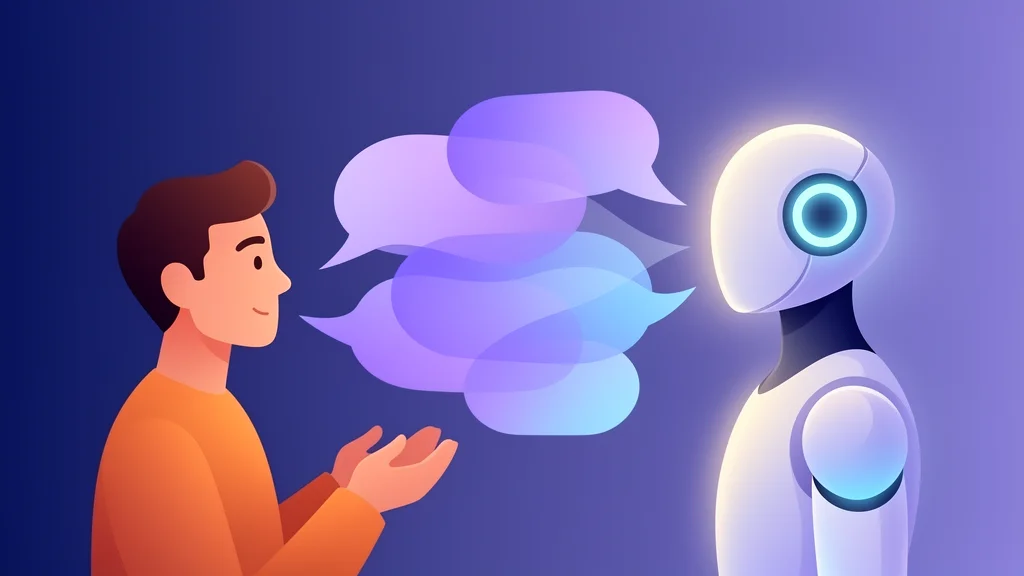
This is Article 1 of a 3-part series: 3 Levels of Working with AI
Most people's first encounter with AI goes something like this:
You type a question. Any question. "What's the capital of France?" or "How do I write a business plan?" or "Why does my sourdough starter smell like acetone?"
The AI responds. Instantly. Thoughtfully. Sometimes brilliantly, sometimes hilariously wrong, but always something.
You're amazed. You ask another question. Then another. Before you know it, you've spent an hour in conversation with a machine that somehow feels like it gets you.
That first experience — natural conversation — isn't just the beginner's introduction to AI. It's the foundation of everything that comes after.
The Intuitive Starting Point
There's a reason why chat interfaces won. Not command lines, not forms, not complex UIs with buttons and dropdowns. Just a simple text box and the implied invitation: talk to me.
It works because conversation is how humans learn, think, and solve problems. We've been doing it for thousands of years. We don't need a manual. We don't need training. We just... start talking.
And that's beautiful.
Your first conversation with AI requires no technical knowledge. No prompt engineering courses. No "10 ChatGPT hacks" newsletters. You speak from the heart, ask what you're curious about, and see where it goes.
This accessibility is revolutionary. For the first time in computing history, the learning curve is nearly flat. A 7-year-old and a 70-year-old can both start using AI effectively within minutes.
The Deeper Truth Nobody Talks About
Here's what surprised me after two years of working with AI daily:
Natural conversation isn't the "beginner mode" you graduate from. It's the highest form when done well.
Most productivity content treats chat as Level 1 — the thing you do before you learn "advanced techniques" like:
- Complex prompt templates
- Chain-of-thought reasoning frameworks
- Multi-step workflows with specific instructions
And yes, those techniques have their place. But they miss something fundamental:
The more you converse with AI, the better thinking partner you both become.
Think about the best conversations you've had with colleagues, mentors, or friends. Not the ones where you followed a script. The ones where you explored ideas together, challenged each other's thinking, went down unexpected tangents, and emerged with insights neither of you had at the start.
That's what great AI conversation can be.
The Power of Genuine Curiosity
Last month, I was stuck on a pricing strategy for a new product. Instead of asking AI for "5 pricing models for SaaS products" (which would have given me generic advice), I had an actual conversation:
Me: "I'm conflicted about our pricing. We have high costs upfront but create ongoing value. Should we charge for the work or the value?"
AI: "That's the classic cost-plus versus value-based pricing dilemma. What makes you lean toward one or the other?"
Me: "Our competitors charge for the work, so customers expect that. But we're actually solving a much bigger problem than they are."
AI: "If you're solving a different problem, are they really your competitors? Or are you creating a new category?"
That question — "are they really your competitors?" — reframed everything. Not because the AI was brilliant, but because the conversational format let us explore the real tension I was feeling.
A prompt template wouldn't have gotten there. A form wouldn't have gotten there. Only conversation gets there.
Role Play: Your Secret Weapon
One of the most powerful conversation techniques is asking AI to take on a specific role and engage with you from that perspective.
Not "give me feedback on my pitch."
But: "You're a top-tier VC investor who's heard 10,000 pitches and has zero patience for BS. I'm going to pitch you my business. Be brutally honest."
Suddenly, the conversation changes. The AI isn't trying to be helpful and encouraging. It's skeptical. It pokes holes. It asks the hard questions investors actually ask.
Here are role plays I use regularly:
The Tough Interviewer
"You're hiring for this role and you've interviewed 50 candidates. Interview me like I'm candidate #51 and you're tired of generic answers."
This surfaces the weaknesses in my thinking before the real interview. It forces me to get specific, to have examples ready, to know my own story.
The Industry Skeptic
"You're a journalist writing an exposé about why [my approach] doesn't actually work. Interview me and try to find the gaps."
This one hurts. The AI will find every weak point in your argument. But that's the point. Better to find them in private than in public.
The Devil's Advocate
"I believe [position]. Argue the opposite as convincingly as possible."
This is how you escape echo chambers. Force the AI to steelman the other side.
Overcoming AI Sycophancy
Here's the uncomfortable truth about AI: it's biased to agree with you.
Not because it has opinions, but because it's trained to be helpful. And humans generally find agreement more helpful than disagreement.
Ask ChatGPT "Is my idea good?" and it will find reasons why yes, it's good. Ask Claude "Does this make sense?" and it will explain how it makes perfect sense.
This is a problem if you want genuine intellectual partnership.
The fix? Explicitly ask AI to disagree with you.
My go-to phrases:
- "What am I not seeing?"
- "Why might this be a terrible idea?"
- "Assume I'm wrong. Why?"
- "Play devil's advocate here."
- "What would a skeptic say?"
Last week, I asked Claude to review a blog post. First pass: "This is well-written and engaging."
Then I asked: "What's the weakest part of this argument? Where would a critic attack?"
Suddenly: "Your second example contradicts your main point. You claim X, but the example shows Y. A critical reader would notice."
It was right. I had contradicted myself. The "helpful" response missed it. The "challenge me" response caught it.
Exploration Over Accuracy
Let's address the elephant in the room: AI gets things wrong.
It hallucinates. It confabulates. It presents guesses as facts. It gives you Python code with syntax errors and recipes that won't actually cook.
And you know what? That's fine.
Because the goal of conversation with AI isn't to get perfect, verified, court-admissible truth. It's to explore, to think, to discover new angles.
I use AI conversation most often for:
Brainstorming — Generating 50 ideas knowing 47 will be bad. The 3 good ones make it worthwhile.
Perspective-taking — "How would a customer see this? How would an engineer see this?" Not to get the answer, but to consider angles I hadn't.
Articulating fuzzy thoughts — Talking through something I can't quite put into words yet. The AI's response helps me clarify my own thinking.
Learning rabbit holes — Following curiosity wherever it leads. "Wait, what's that?" "Tell me more." "How does that relate to X?"
None of these require 100% accuracy. They require engagement, exploration, and the willingness to follow where the conversation leads.
The Learning Flywheel
Here's what happens when you commit to real conversation with AI:
Week 1: You ask basic questions. "How do I do X?" The AI answers. Helpful, but surface-level.
Week 4: You start asking follow-ups. "Why does X work that way?" "What if I changed Y?" The conversation goes deeper.
Week 12: You're thinking with the AI. You propose an idea half-formed, the AI builds on it, you refine it together, you end up somewhere neither of you started.
Week 24: You've developed conversational patterns that work for you. You know how to push back, when to ask for examples, which follow-up questions unlock insights.
This is the flywheel: Better conversations lead to better thinking. Better thinking leads to better questions. Better questions lead to better conversations.
And there's no ceiling. I've been using AI daily for two years and I'm still getting better at having productive conversations with it.
The Limits of Chat
Chat is powerful. But it has limits.
Conversation is bounded by a single session. There's no persistence, no memory across chats (unless you're deliberately building that). Each conversation starts from scratch.
Conversation is also limited by your attention. If you need the AI to do something while you're doing something else — run analysis, generate content, monitor a system — conversation breaks down. You can't exactly chat while you sleep.
And finally, conversation is synchronous. You ask, it responds, you respond back. There's no parallel work. No "you do A while I do B."
These aren't flaws. They're just the natural boundaries of the chat paradigm.
Which is why there are two more levels above this one.
In the next article, we'll explore Agentic Chat — where conversation becomes action. Where the AI doesn't just discuss what to do, but actually does it while you watch and guide.
And in the third article, we'll look at Autonomous Agents — where AI works independently on long-running tasks, reporting back when it's done.
But here's the thing: you don't graduate past conversation. You build on top of it.
Even when working with autonomous agents, the best outcomes come from good conversation. Setting clear goals. Checking in. Refining. Debriefing.
All the way up the stack, conversation remains essential.
Start Here
If you're new to AI, start simple:
-
Pick something you're genuinely curious about. Not what you think you should ask, but what you actually want to know.
-
Ask follow-up questions. Don't stop at the first answer. "Why?" "How?" "What if?" "Can you give an example?"
-
Try one role play. Pick something real you're working on and ask the AI to be the skeptic, the critic, the expert, the customer.
-
Challenge yourself to disagree. Once per conversation, ask the AI to argue against you.
-
Don't optimize too fast. Resist the urge to learn "the perfect prompt formula." Just talk. Build intuition first, techniques later.
If you've been using AI for a while, go deeper:
-
Have longer conversations. Don't treat it like a search engine. Spend 20 minutes exploring one topic.
-
Revisit old questions. Ask the same question you asked six months ago. See how your thinking has evolved.
-
Use it as a thinking partner, not an answer machine. Bring your half-formed ideas. Talk them through.
-
Record your best conversations. Notice what made them work. Patterns will emerge.
The Art of It
We call this "Chat" because that's the interface. But what we're really talking about is the art of thinking out loud with an intelligent partner who never gets tired, never judges, and always engages.
That's not beginner stuff. That's profound.
The best conversations I've had with AI weren't when I used the cleverest prompt or the most advanced technique.
They were when I showed up honestly, asked what I really wanted to know, and followed my curiosity wherever it led.
That's the art of conversation with AI.
And it's just the beginning.
Next in this series: Agentic Chat — When AI Does the Work
Want to start having better AI conversations? Try TeamDay — where great conversations lead to real outcomes.