
Self-Running Companies
/sɛlf ˈrʌnɪŋ ˈkʌmpəniz/
Also known as: autonomous companies, AI-run businesses, self-operating companies, autonomous business operations
What are Self-Running Companies?
Self-running companies are businesses where AI agents handle the majority or all of the operational functions — engineering, marketing, sales, customer support, and advertising — with minimal or no human intervention. Unlike traditional automation that handles individual tasks, self-running companies use AI agents as autonomous operators that make strategic decisions, execute across functions, and adapt based on business outcomes.
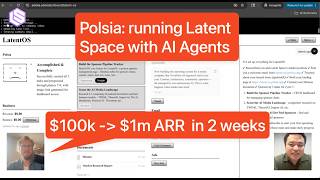
The concept emerged in 2025-2026 as AI models became capable enough to handle complex, multi-step business operations. Platforms like Polsia provision complete business infrastructure (web servers, databases, email, payment processing, ad accounts) and deploy AI CEO agents that execute nightly work cycles: evaluating business metrics, deciding on priorities, executing tasks, and reporting results.
Key Characteristics
- Autonomous decision-making: An AI CEO agent evaluates business state and decides what to work on without human instruction
- Full-stack operations: AI handles engineering, marketing, sales, support, and advertising simultaneously
- Provisioned infrastructure: The platform provides all necessary business tools rather than requiring users to connect existing accounts
- Human-in-the-loop guidance: Founders provide strategic direction via chat or email, while AI handles execution
- Nightly execution cycles: Work happens asynchronously, with daily progress reports sent to the founder
Why Self-Running Companies Matter
Self-running companies represent a fundamental shift in entrepreneurship. Traditionally, starting a business required either significant capital (to hire a team) or significant time (to do everything yourself). Self-running company platforms reduce both requirements to a subscription fee and daily strategic input.
The implications extend beyond startups. If AI can autonomously operate a small business — handling everything from product development to customer acquisition — the same capabilities can be applied to departments within larger organizations. Every business function that can be described as a set of goals and constraints becomes a candidate for autonomous AI operation.
Historical Context
The concept builds on several converging trends:
- AI agents (2024-2025): AI systems that use tools and take actions, not just generate text
- Model capability improvements: Claude Opus 4.6 and similar models achieving reliable reasoning for business decisions
- Infrastructure-as-code: Cloud platforms enabling programmatic provisioning of full business stacks
- The solo founder movement: Growing number of founders running businesses with minimal or no employees
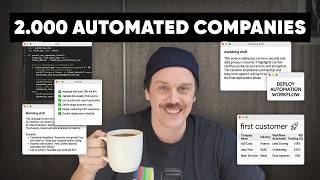
Ben Broca’s Polsia, which reached $1.8M ARR as a one-person operation managing 2,000+ autonomous companies by March 2026, became one of the first prominent examples of this model. Broca frames the user relationship as an investor-CEO dynamic: the AI operates as CEO while the human provides strategic direction as either a passive investor (daily email reports, no input needed) or an active investor (hands-on guidance).
Related Reading
- AI Agents - The underlying technology enabling autonomous operations
- Ben Broca - Founder of Polsia, a leading self-running company platform
- Model Commoditization - Why platform value matters more than model choice
Mentioned In
Ben Broca
Pulsia crossed $1.8M ARR with 2,000+ companies. Broca treats users as investors (passive or active) and the AI as CEO, with plans to make Pulsia fully autonomous and give it 10% equity.
Ben Broca
Polsia is an AI that builds and runs companies autonomously. You give it an idea and it will do product coding, marketing, sending emails, launching meta ads, competitive research -- essentially everything you would do as a founder.