

Mike Cannon-Brookes
Co-founder & CEO at Atlassian
Co-founder and CEO of Atlassian. Advocates that businesses are processes, not filing cabinets, and that design is AI's biggest bottleneck.
About Mike Cannon-Brookes
Mike Cannon-Brookes is the co-founder and CEO of Atlassian, the collaboration software company behind Jira, Confluence, Trello, and Bitbucket. He co-founded Atlassian in 2002 with Scott Farquhar from a Sydney apartment, growing it into a company serving over 300,000 customers globally.
In the AI era, Cannon-Brookes has been vocal about what he sees as the real challenges: not model capability, but design and experience. He argues that AI’s power massively outstrips the UX to deliver it, creating a design bottleneck that determines adoption more than technology does.
Career Highlights
- Atlassian (2002-present): Co-founder and CEO, built from a two-person startup to a public company
- Teamwork Graph: Led development of Atlassian’s organizational knowledge layer for AI
- Rovo: Atlassian’s AI platform that integrates agents into workflows across Jira and Confluence
- Climate advocacy: Major investor in renewable energy and sustainability in Australia
Notable Positions
On Businesses as Processes
Cannon-Brookes challenges the “system of record” framing, arguing businesses are fundamentally process-based:
“Businesses are a set of processes. They’re not a system of record. Your ability to coordinate a set of processes as cheaply and efficiently and quickly as possible is actually, in a knowledge business, your entire business.”
On Input vs. Output Constrained Work
He distinguishes two types of business processes that need fundamentally different AI strategies:
- Input-constrained (customer service, legal): Fixed demand, AI optimizes throughput and cost
- Output-constrained (creative, engineering): Unlimited potential, AI amplifies output rather than reducing headcount
On the Design Bottleneck
“Give people a chat box that can do unlimited power and they’re like, ‘tell me a dad joke.’ The underutilized capabilities are so big. It’s almost trite now to say the models are far ahead of the value they’re delivering.”
Key Quotes
- “The filing cabinet can do work.” (on the paradigm shift from database-era software to AI-era software, 2026)
- “The problem with having 50 interns is they ask you 50 questions a minute.” (on the challenge of managing multiple AI agents, 2026)
Related Reading
- Alex Rampell - Co-panelist on a16z podcast discussing SaaS disruption
- SaaS-to-AI Transformation - The trend Atlassian is navigating
- Vibe Coding - The phenomenon Cannon-Brookes sees as making SaaS stickier via extensibility
Video Mentions
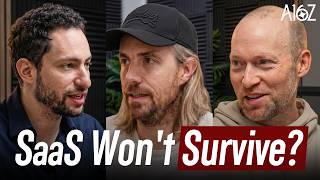
SaaS apocalypse and AI agent design challenges
On the a16z podcast, argued that businesses are processes not systems of record, distinguished input-constrained vs output-constrained processes, and identified design as AI's biggest adoption bottleneck.