
Agents as Employees
AI agents are shifting from assistants to autonomous workers with credentials, identity, and purchasing authority
The Shift from Assistants to Employees
For years, the dominant framing of AI in the workplace has been “copilot” — a helpful assistant that augments human workers. A new paradigm is emerging: AI agents treated not as tools but as employees. They receive credentials, identity, purchasing authority, and task assignments. They are managed, reviewed, and evaluated the same way human staff are.
This is not a metaphor. Companies are literally assigning agent identities in their systems, giving them access to purchase software, triage customer support, write and deploy code, and manage workflows. The relationship between organization and agent increasingly mirrors the employer-employee relationship — minus the HR overhead.
Key Drivers
1. Autonomous Agent Capabilities
The foundation is technical: agents have crossed the threshold from “needs constant supervision” to “can be trusted with real work.” OpenClaw, NanoClaw, and similar frameworks have demonstrated autonomous coding, customer support triage, and workflow management that operate without human review for routine tasks.
2. Economic Pressure
The math is straightforward. Jerry Murdock (Insight Partners) notes that SMBs see the most immediate impact — a single AI “employee” handling customer service dramatically changes the economics of a 3-4 person company. Klarna’s Sebastian Siemiatkowski demonstrated it at scale, cutting 50% of headcount while expanding into new product lines without additional budget.
3. Consumption-Based Business Models
When agents are the buyers, pricing shifts from seat-based licensing to consumption-based models. Docker, E2B, and others are already moving toward this — the agent uses a service, you pay for what it consumed. This eliminates the human procurement cycle entirely.
Who’s Saying This
Jerry Murdock (Insight Partners):
“Software is going to be purchased or used by agents. An autonomous agent becomes an employee. You give it credentials. You give it identity. And then it’s up to the agent to make the decision.”
Sebastian Siemiatkowski (Klarna):
“I don’t have to deal with sick leave. I don’t have to deal with entitled millennials.” (While provocative, this captures the operational reality of agent-staffed companies.)
Implications
For Software Companies
Your next customer may not be human. Software that cannot be consumed by agents — that requires human-facing UIs, manual configuration, or per-seat licensing — faces obsolescence. APIs, consumption-based pricing, and agent-accessible interfaces become table stakes.
For the Labor Market
Murdock predicts the first impact hits new hires, not current employees. Companies stop hiring junior developers, assistants, and marketing staff. The effect cascades from SMBs (fastest adoption) to enterprise (slowest, but inevitable). He predicts this will be a defining political issue within two and a half years.
For Investors
Evaluating startups now requires assessing how well founders deploy agents. Murdock argues that the quality of a company’s autonomous agent usage will become a deciding factor in venture capital decisions, putting human investors and AI-native startups on the same playing field.
Timeline
| Date | Event |
|---|---|
| 2024 | Copilot era peaks — agents still assistive |
| 2025 | OpenClaw, NanoClaw, and custom agents begin autonomous coding |
| 2026-Q1 | Portfolio companies report Cursor “obsolete” — agents write code independently |
| 2026-02 | Anthropic’s 16-agent team builds 100k-line C compiler in 2 weeks ($20k) |
| 2026-02 | Jensen Huang declares “the market got it wrong” — agents amplify tools, not replace them |
| 2026-H2 | Enterprise adoption begins at scale |
| 2028 (projected) | AI labor displacement becomes electoral issue |
Related Reading
- AI Agents - The technology enabling the shift
- Agent Orchestration - How agent workforces are coordinated
- Knowledge Work Disruption - The broader labor market impact
- Jerry Murdock - Key voice on agents as employees
Expert Mentions

Jerry Murdock
An autonomous agent becomes an employee. You give it credentials. You give it identity. And then it's up to the agent to make the decision. You will review them like an employee — what did you buy, what did you spend, what did you accomplish.

Sebastian Siemiatkowski
We've gone from 7,000 people, we're now below 3,000. We've shrank 50%. And I didn't ask for a single dime to do all this.

CNBC (Jar Dosa)
AI went through its third inflection — agents able to reason, take task, and actually do work. Lawyers using agents to build entire cases, marketers to launch full campaigns. People who have never written a line of code are building software.
Nicholas Carlini
16 Claude agents working in parallel produced a 100,000-line C compiler in two weeks for $20,000. Passes 99% of GCC torture test, compiles Linux kernel.
Jensen Huang
Nvidia has 42,000 biological employees and hundreds of thousands of digital employees coming. The number of software tools consumed is growing because agents use more tools than humans.
Amelia & Jason Lemkin (SaaStr)
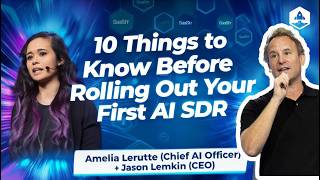
SaaStr's AI SDR agents reduced event production agency hours to less than a tenth. 1.5M sessions on Qualified in 6 months. Agents handle sponsor check-ins, ticket sales, and lead follow-up that humans refused to do. 99% of people prefer talking to AI over waiting for a human response.

Shann Holmberg
One person doing the work of a small team. The coordination cost drops to zero. An 8-person team runs 38 agents across 8 departments. At level 5, AI marketing is infrastructure — an OS you run, not a tool you open.

Jon McNeill
AI agents as exoskeleton — supply chain experts wield AI agents that learn client workflows in hours, replacing 9-12 month ERP rollouts. Domain expertise judges what agents return, then redirects.