
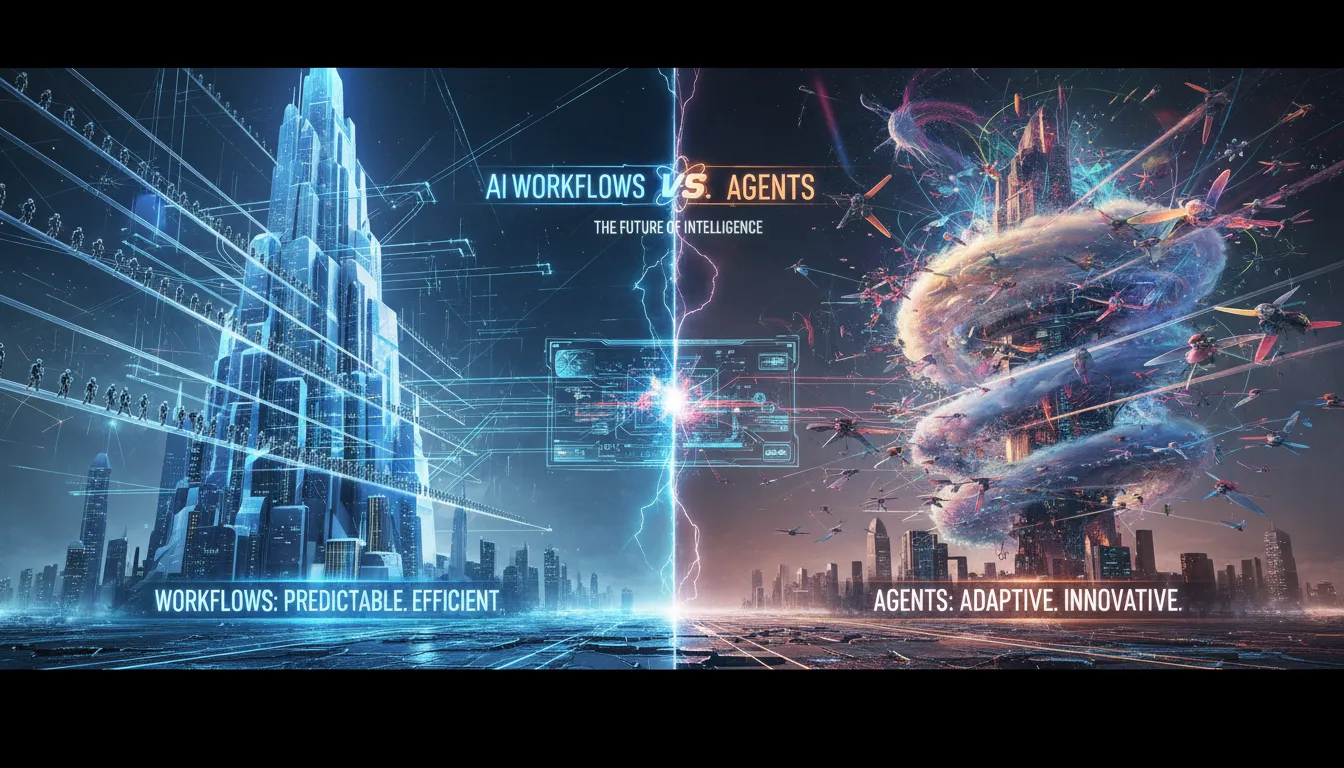
Automation is at a crossroads. On one side: set workflows — visual flowcharts, rigid nodes, explicit logic. On the other: agentic execution — autonomous AI agents that plan, adapt, and improvise.
At TeamDay.ai, we believe the future belongs to agents. Workflows solved yesterday’s problems. Agents solve tomorrow’s.
🛠️ What Are Set Workflows?
Set workflows are the automation equivalent of assembly lines: predictable, repeatable, and locked into a rigid design. You drag blocks, wire up APIs, test the branches, and deploy.
They deliver consistency — but consistency comes at the price of adaptability.
Popular Workflow Platforms
- n8n — open-source workflow automation with a visual UI
- Make (formerly Integromat) — no-code automation builder
- LangChain / LangGraph / LangSmith — developer tools for chaining LLM steps
✅ They shine for stable, low-variance tasks.
❌ But when the environment shifts, they break.
🤖 What Is Agentic Execution?
Agentic execution is the opposite mental model: you set the goal, not the path. The agent figures out the plan, chooses the tools, and adapts if the unexpected happens.
Instead of programming “how,” you define “what.”
Popular Agentic Tools
- Claude Code — Anthropic’s AI-first coding agent
- Codex — OpenAI’s original code execution model
- Gemini CLI — Google’s experiments with agentic dev tools
- Lightweight custom patterns — composable loops and planners (often simpler, more robust than bloated frameworks)
✅ They thrive in dynamic environments.
❌ They demand trust, oversight, and sometimes guardrails.
⚖️ The Core Divide: Control vs. Autonomy
| Dimension | Set Workflows | Agentic Execution |
|---|---|---|
| Control | Explicit, human-scripted | Emergent, AI-driven |
| Predictability | High, repeatable | Variable, adaptive |
| Transparency | Clear logic, easy to audit | Opaque reasoning, harder to debug |
| Adaptability | Rigid, breaks when conditions change | Flexible, re-plans in real time |
| Mental Model | Flowcharts | Conversations |
🚀 Why We Bet on Agents
Workflows had their moment. They gave businesses drag-and-drop power and freed people from tedious scripting. But they lock the future into the past: brittle, over-engineered, and unable to keep pace with change.
Agents, on the other hand, are like hiring a smart teammate. You don’t tell them which box to click in what order — you tell them the goal, and they adapt.
The frontier of AI isn’t in drawing prettier flowcharts. It’s in letting AI act with autonomy, guided by human goals. That’s where compounding leverage comes from: daily advice, dynamic problem-solving, and emergent strategies no workflow designer could anticipate.
📝 Final Word
The choice is stark:
- Stick with set workflows if you want predictable robots.
- Move to agents if you want adaptive teammates.
At TeamDay.ai, we’ve made our bet. We don’t believe the future of automation will be drawn with boxes and arrows. It will be lived through agents that think, plan, and act.
Because in the end, the world doesn’t run on flowcharts. It runs on people — and the AI agents that work alongside them.