

Every footwear team knows this feeling. A new drop goes live — 47 colorways of the same silhouette, each needing a product description, a size-and-fit guide, a PDP headline, Instagram captions, and a Pinterest description. The merchandising team exported the SKU sheet three days ago. The copywriters are underwater. Marketing wants the social posts by end of day.
The product launches anyway. Half the descriptions are copied from last season. The size guide says "see similar style." Three markets get English copy.
This isn't a creative problem. It's a scale problem.
<video autoplay muted loop playsinline preload="metadata" poster="/images/footwear-agent-hero-poster.webp" aria-label="A sneaker rotating slowly on a minimalist studio pedestal" style="width: 100%; height: auto; border-radius: 0.75rem; margin: 2rem 0; display: block;"

Have a product photo of your own? Create a short product video in Teamday. Add your photo, describe the motion, and review the result for product accuracy. Video generation requires your organization's own compatible video provider, which bills usage separately from your Teamday subscription.
Why Footwear Content Is Uniquely Hard
Footwear is one of the most demanding e-commerce categories for content operations. A single sneaker silhouette might generate 60+ SKUs across colorways, sizes, and widths. A seasonal collection might introduce 200 new products in a single month. A global brand runs 12+ storefronts in different languages.
Each product needs:
- PDPs (product detail pages) — headline, description, bullet specs, size guide, care instructions
- Category copy — contextual content that helps search engines understand what the shoe is
- Social content — Instagram captions, TikTok hooks, Pinterest descriptions, each with its own voice
- Market-specific variants — localization that goes beyond translation (sizing conventions differ by country; "sneaker" means something different in the UK)
- Review synthesis — pulling themes from customer reviews to reinforce or correct product claims
- Campaign narratives — seasonal stories that connect individual products to a larger brand moment
A mid-size DTC sneaker brand with 800 active SKUs needs roughly 4,000–6,000 individual content pieces per year to stay current. A luxury house launching twice-yearly collections needs fewer pieces but at a far higher standard. A performance running brand needs technically accurate copy that would embarrass them if it was wrong.
Manual content pipelines buckle under this load. The result is stale copy, inconsistent brand voice, missed market opportunities, and copywriters spending 80% of their time on low-value first drafts.
What Agents Do That AI Tools Don't
Before going further: the difference between an AI writing tool and an AI agent matters here. It's not a marketing distinction. It changes what's actually possible.
An AI writing tool is a vending machine. You insert a prompt, you get output. It has no memory of what it generated yesterday. It doesn't know your inventory changed. It can't trigger the next step in your workflow. You have to drive it every single time.
An AI agent is more like a contractor who works autonomously on a project. Agents have:
- Memory — they know your brand guidelines, what they generated last week, what performed well and what didn't
- Tool use — they can read your inventory feed, query your PIM system, call your translation API, post to your CMS
- Autonomous operation — they run on schedules, respond to triggers (new SKU added), and coordinate with other agents
- Iteration — they can review their own output against a rubric and revise before the human ever sees it
The practical difference: an AI tool requires a human to drive each interaction. An agent runs the pipeline. The human reviews outcomes, not inputs.
For a footwear brand, that distinction is the difference between "we use AI to help write product descriptions" and "our content pipeline runs itself."
The Footwear Content Agent Stack
Here's what a realistic agentic content setup looks like for a DTC sneaker brand. Not theory — the components to build this exist today.
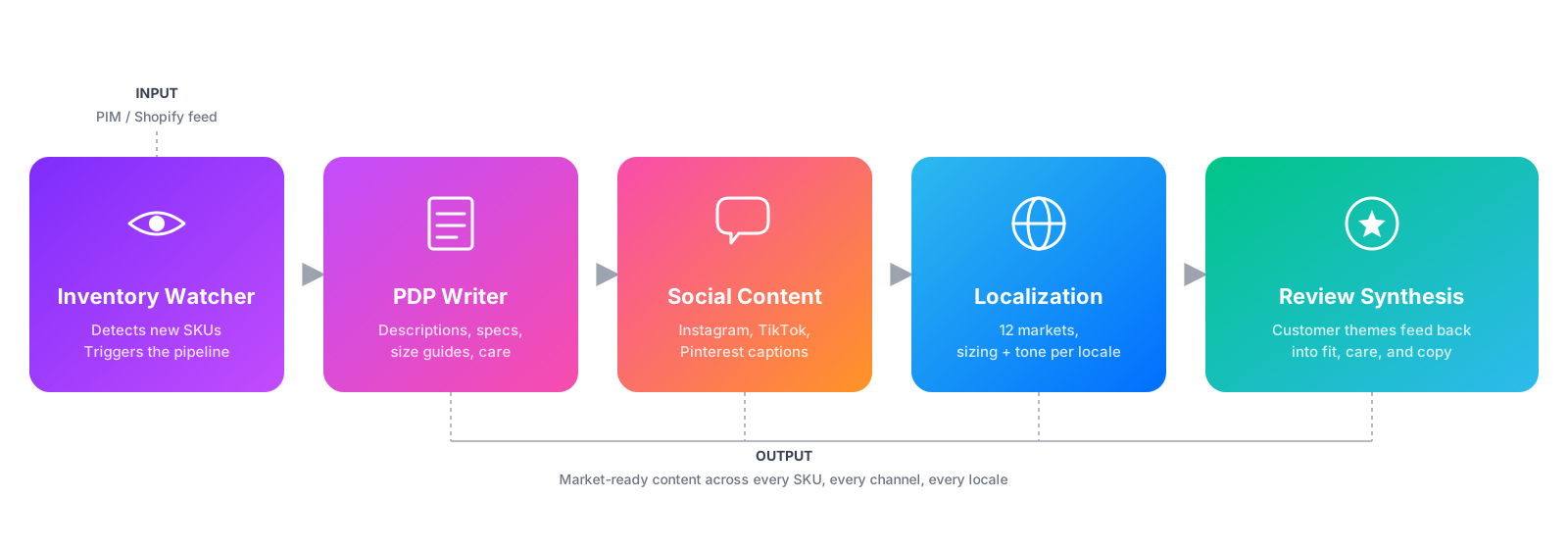
The Inventory Watcher
This agent monitors your product information management (PIM) system or Shopify product feed. It detects when a new SKU is added or when a product status changes (new launch, restock, discontinued, price change).
When a new product appears, it doesn't just log it — it kicks off the downstream pipeline. It reads the raw product attributes: upper material, sole construction, last shape, colorway name, intended use. It understands enough about footwear to know that "full-grain leather upper with a welt construction" signals a dress shoe, not a trail runner.
What it triggers: content generation agents for that SKU.
The PDP Writer
The product detail page agent gets the raw attributes and the brand voice guidelines. It doesn't write generic copy — it knows whether this is a lifestyle brand selling a feeling or a technical brand selling a performance advantage.
For Stride Athletic (a running shoe company), the PDP copy leads with the tech: "ReactFoam midsole delivers 68% energy return across 500+ miles without compression set." Specific, credible, measurable.
For Maison Pelletier (a luxury house), the same structural shoe translates differently: "Hand-lasted over a bespoke wooden form, the upper molds to the foot across three wearings." Craft, not specs.
The agent understands these distinctions because the brand voice is defined precisely in its system prompt — not as vague directives like "be premium," but as actual approved language, vocabulary to avoid, and example sentences at each tone level.
Typical output per SKU:
- PDP headline (2 variants for A/B testing)
- Full product description (150–250 words)
- 5–7 bullet spec points
- Size-and-fit recommendation (referencing last shape and width notes)
- Care instructions (material-specific)
The Social Content Agent
The social agent operates with a different constraint set. It knows the platform, the character limit, the current campaign hashtags, and what the brand has already posted. It doesn't generate content in a vacuum — it reads the campaign brief for the season and writes within it.
For a spring drop, the campaign brief might be: "This collection is about transition — the last cold morning, the first warm run. We're leaning into the emotional quality of that moment." The social agent produces captions that live inside that narrative, not generic product announcements.
It also adapts for platform:
- Instagram: 2–3 lines, product-forward, hooks the first line
- TikTok: conversational, curiosity gap opener, no hashtag spam
- Pinterest: discovery-oriented, benefit-led, longer form acceptable
One product, five platforms, different voices — all consistent with the brand. And because the agent tracks what has been posted, it doesn't repeat similar copy in the same week.
The Localization Agent
Here's where most brands feel the pain most acutely. Translation is not localization. A translated description for the German market that still references US sizing, uses American idioms, and doesn't know that European customers expect EU size ranges front-and-center — that's not localization, it's embarrassing.
The localization agent doesn't just translate. It:
- Converts sizing conventions (US to EU, UK, JP)
- Adapts material descriptions for regional preferences (some markets respond to sustainability credentials; others prioritize durability claims)
- Adjusts formality registers (formal German, informal French, highly polite Japanese)
- Flags potential trademark or regulatory issues in specific markets
Running a 12-market operation? The localization agent produces 12 market-ready variants from one approved English master. No email chains to translation vendors. No 72-hour turnaround. The pipeline completes in minutes.
The Review Synthesis Agent
Customer reviews are an underused content asset. A product with 300 reviews contains patterns: what do customers consistently love? What do they get wrong about fit? What terminology do real buyers use?
The review synthesis agent reads the reviews, identifies themes, and does two things:
- Updates the product copy — if 40% of reviews mention that this shoe runs a half-size small, the size guide should reflect that
- Extracts authentic language — customers describing the cushioning as "like walking on a cloud" is user language that can inform marketing copy in a way that resonates
This agent runs on a schedule, not just at launch. As reviews accumulate, the product content evolves.
A Real-World Scenario: The Spring Drop
Let's make this concrete. Stride Athletic is a DTC performance running brand with 120 active SKUs. They launch a spring collection: 8 new shoes, 3 colorways each, totaling 24 new products.
Before agents (their old process):
- Day 1: Merchandising exports SKU sheet, sends to copywriter
- Days 2–5: Copywriter drafts PDPs, emails for review
- Day 6: Brand manager reviews, sends back with edits
- Day 7: Second round of revisions
- Day 8: Finalized English copy sent to translation vendor
- Days 9–11: Translation turnaround (paid per word)
- Day 12: Translations reviewed internally (nobody really checks)
- Social team writes captions the week of launch, under pressure
Total time: 12+ days. Involved: 4–6 people. Translation cost: ~$800 per collection.
With agents:
- Day 1 at 9am: Merchandising adds new SKUs to PIM system
- Day 1 at 9:15am: Inventory watcher detects 24 new products, triggers pipeline
- Day 1 at 11am: PDP writer completes all 24 product descriptions (2 headline variants each), size guides, and bullet specs
- Day 1 at 11:30am: Social agent generates platform-specific captions for each product (Instagram, TikTok, Pinterest) — 72 pieces of social content
- Day 1 at 1pm: Localization agent produces versions for EN-GB, DE, FR, JP, KR — 5 markets × 24 products = 120 localized PDPs
- Day 1 at 2pm: Content director receives summary report with everything for review
- Day 2: Human review, light editing of 10–15% of the content, approvals
- Day 3: Launch with complete, localized content across all markets and platforms
Total time: 3 days. Involved: 1 content director (reviewing, not producing). Translation cost: $0.
That's not a marginal improvement. That's a different operating model.
The Technical Specs Challenge
Footwear has an underappreciated content challenge: technical precision.
A running shoe description that says "responsive foam cushioning" is fine for lifestyle content. But a brand selling to serious runners needs to be specific: compression set percentage over 300 miles, heel-to-toe drop in millimeters, stack height, last width measured at the ball of foot. Get those numbers wrong in copy and you'll hear about it in reviews — and potentially face returns.
An agent handling technical footwear content needs to be trained to respect the difference between marketing claims and technical specifications. The spec table is data, not marketing language. The description is where claims live — and claims need to be grounded in the specs.
The way this works in practice: the product agent is given both the raw spec data and the brand copy guidelines, and explicitly instructed on which claims can be made, which need to be attributed to specs, and which are off-limits. A brand with IP around their cushioning tech, for instance, might have specific language they own around that technology — the agent knows those terms and uses them precisely.
Seasonal Campaigns: The Agent That Knows the Story
A product description lives forever on the PDP. Campaign content has a shelf life. The agent writing Spring 2026 campaign copy needs to know the seasonal narrative — but also needs to sunset that content on a schedule, so your homepage doesn't feature spring messaging in October.
Campaign content agents work from a brief. The brief defines the emotional territory, the hero products, the visual direction (for alt text and creative briefs), and the campaign lifespan. The agent writes within those parameters and knows when to stop.
For Maison Pelletier's autumn capsule — a collection drawing on archival silhouettes from the 1990s archive — the agent needs to understand the campaign is about heritage and recontextualization, not nostalgia. The copy should feel modern despite the historical references. It shouldn't say "classic" when it means "enduring." It shouldn't say "retro" when the positioning is "timeless."
These distinctions sound like they require a human with taste. What they actually require is a well-specified brief. An agent given a clear brief, a few approved examples, and explicit vocabulary guidance produces campaign copy that fits the intent — at a rate that would bankrupt a luxury brand if they paid agency rates.
The Before and After No One Talks About
The before/after everyone focuses on is speed. And yes, agents are dramatically faster.
But the more important before/after is coverage.
Before agents, a brand with 800 SKUs has good copy on the top 100 — the heroes, the bestsellers, the products that get marketing attention. The long tail (products 101–800) has copy that was written once, never updated, and reflects neither the current brand voice nor what customers actually think about the product.
With agents, the long tail gets treated like the hero product. Every SKU gets fresh copy, current seasonal framing, and review-informed updates. The long tail becomes a content asset instead of a content liability.
For SEO, this is significant. Well-written, unique product copy across the entire catalog means every product page can rank for its specific queries. A generic copy template means you have 800 pages that look the same to search engines.

What Still Requires Humans
Let's be direct about the limits, because overpromising helps nobody.
Agents should not be the final word on:
- Photography direction — the agent can write a brief for a product shoot, but aesthetic judgment about what makes the image right for the brand stays human
- Campaign naming and big creative ideas — the seasonal campaign narrative, the campaign name, the headline concept that becomes the creative territory — these originate with humans
- Controversial or sensitive content decisions — a product association with a cultural moment, a partnership announcement, anything that involves brand risk
- Final copy approval — even a well-performing agent pipeline benefits from a human content director reviewing batches before they go live
The pattern that works: agents produce, humans curate. The ratio shifts dramatically — instead of humans producing 100% and reviewing 100%, humans review 100% and produce 0%. That's still a 5–10x productivity gain on the content side, with humans spending their time on judgment rather than drafts.
The ROI Is Not in Speed — It's in Coverage
The business case for agentic content in footwear isn't "write product descriptions 10x faster." It's "operate a content program at a scale that was previously impossible without headcount you can't afford."
A typical footwear brand's content team: 2–4 copywriters, 1 content strategist, and a localization vendor relationship. Realistic output: maybe 50–80 high-quality content pieces per month across all needs.
With an agentic pipeline, that same team's output capacity multiplies by 10–20x — not because the humans work faster, but because the agents handle the first 90% of every content task. The humans do what only humans should do: set direction, approve, refine.
For growing DTC brands, this changes the economics of international expansion. You don't need a local content team in each market. The localization agent handles the German market at the same quality as the English market, at zero marginal cost per SKU.
For luxury houses, it means maintaining the appearance of hand-crafted copy at scale — which is the appearance they need even if the production isn't hand-crafted.
For performance brands, it means every product page is technically accurate and current, reviewed against actual specs, not written from memory by a copywriter who has never worn the shoe.
The Full Content Supply Chain: What's Coming
The agents described above handle existing workflows. The next phase is agents that create new workflows that weren't economically viable before.
Demand-signal content: an agent that monitors Google Trends, search volume shifts, and social listening — then generates content targeting emerging queries before competitors notice them. A running brand's agent detects that searches for "cushioned trail shoes for heavy runners" are surging and triggers content specifically for that segment.
Post-purchase content sequences: an agent that knows when a customer received their order and generates personalized care instructions, break-in guides, and "how to style this" content based on which product they bought.
Influencer brief generation: when a brand works with micro-influencers, an agent builds a personalized brief for each creator based on their audience profile, past content, and the product being sent — instead of one generic briefing document sent to everyone.
Competitive positioning updates: an agent that monitors competitor product launches and flags when your copy is making claims that competitors now match — so you can update to maintain differentiation.
The full content supply chain — from trend detection to product creation to launch to post-purchase — can run with minimal human direction. The humans stay in the loop at decision points, not execution points.
Getting Started
The path from "we use AI occasionally" to "we run an agentic content pipeline" doesn't require a platform rebuild. It requires:
- A clean product data source — your PIM or Shopify feed, structured and up-to-date. Garbage in, garbage out remains true.
- A documented brand voice — not a vague style guide, but actual approved examples, vocabulary, and explicit rules. The more specific, the better the output.
- Defined agent roles — who handles what, what each agent is allowed to publish vs. what requires review
- A review workflow — not for every piece, but a sampling protocol that catches systematic errors before they become catalog-wide problems
The footwear brands that move first on this will build a compounding advantage: better-covered catalogs, faster market launches, and a content team that operates above the copy treadmill.
The brands that wait will keep running the treadmill with more runners.
Try It
TeamDay runs agentic content pipelines across e-commerce, publishing, and marketing teams. If you're managing a footwear catalog and want to see what an agent-driven content operation looks like for your specific setup —
Configure your first content agent in an afternoon. See what it produces before you commit.
Related: Autonomous AI Agents — Set It and Forget It | AI WordPress Management | Long-Running AI Agents